 English



In cell culture experiments, a sterile environment, precise control of gas composition and pH, and appropriate osmotic pressure are essential for healthy cell growth. In large-scale cell culture applications such as vaccine production and monoclonal antibody manufacturing, cell factory play a critical role due to their high efficiency and stability. However, the quality of cell factories directly affects cell growth performance, making strict quality control especially important.
Hemolysis testing is a key component of quality evaluation for cell factories, designed to assess the potential impact of materials on blood cells. When cells come into contact with device surfaces or material extracts, hemolysis may occur, leading to membrane rupture and the release of intracellular components. This not only damages cell viability but can also compromise the entire cell culture process.
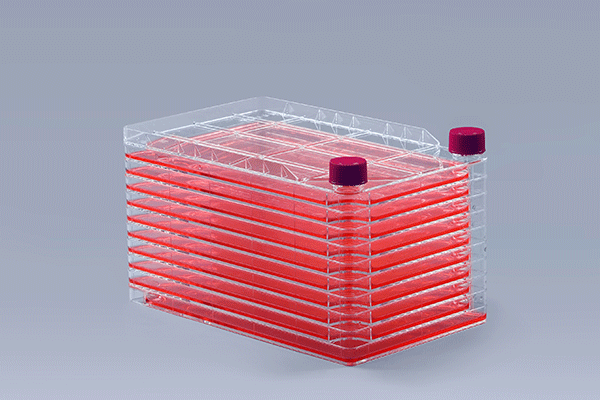
In accordance with ISO 10993-4:2017 and GB/T 16886.4-2003, hemolysis testing is conducted on cell factory products. Test samples, along with negative and positive controls, are incubated with fresh anticoagulated rabbit blood. The absorbance is then measured using a UV-visible spectrophotometer to calculate the hemolysis rate. A hemolysis rate of no more than 5% is required to confirm material safety.
Hemolysis testing serves not only as a stringent assessment of cell factory material quality, but also as a vital safeguard for cell culture safety. Through this test, potentially leachable compounds that could induce in vitro red blood cell hemolysis can be identified and eliminated, preventing adverse effects caused by non-compliant culture vessels.
In conclusion, cell factories play an indispensable role in modern cell culture, and hemolysis testing is a critical measure to ensure their quality and safety. Only cell factories that have successfully passed rigorous hemolysis testing can provide a stable and reliable environment for cell cultivation, thereby supporting continuous progress in life science research.
The FAI climbed 5.9 percent year-on-year in the first 11 months of 2018, quickening from the 5.7-percent growth in Jan-Oct, the National Bureau of Statistics (NBS) said Friday in an online statement.
The key indicator of investment, dubbed a major growth driver, hit the bottom in August and has since started to rebound steadily.
In the face of emerging economic challenges home and abroad, China has stepped up efforts to stabilize investment, in particular rolling out measures to motivate private investors and channel funds into infrastructure.
Friday's data showed private investment, accounting for more than 60 percent of the total FAI, expanded by a brisk 8.7 percent.
NBS spokesperson Mao Shengyong said funds into weak economic links registered rapid increases as investment in environmental protection and agriculture jumped 42 percent and 12.5 percent respectively, much faster than the average.
In breakdown, investment in high-tech and equipment manufacturing remained vigorous with 16.1-percent and 11.6-percent increases respectively in the first 11 months. Infrastructure investment gained 3.7 percent, staying flat. Investment in property development rose 9.7 percent, also unchanged.