 English



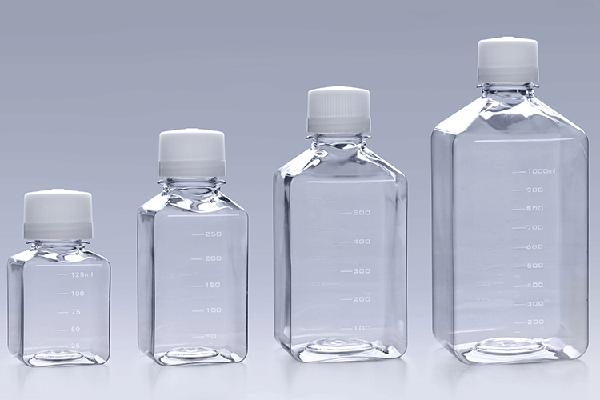
In biological laboratories, Square Media Bottles are dedicated containers for storing culture media. Their quality directly affects media stability and the reliability of experimental results. To ensure consistent high quality, the manufacturing process must be precisely controlled. So how are Square Media Bottles produced? Below is a detailed breakdown of the core production steps.
1. Material Selection and Preheating
Square Media Bottles are typically made from transparent PET material, which offers excellent clarity, chemical resistance, and mechanical strength. Before production, the PET preforms are preheated to ensure optimal plasticity during the subsequent blow molding process.
2. Stretching Stage
After preheating, the preforms are transferred into the mold, where a stretch rod moves downward to stretch the preform along its axial direction. The stretching speed is a critical parameter:
Excessive speed: Too much material accumulates at the bottle base, while insufficient material remains in the upper body, resulting in reduced mechanical performance.
Insufficient speed: Too little material remains at the bottle base, also compromising overall strength.
Precise control of the stretching speed ensures uniform material distribution along the axial direction.
3. Pre-Blowing Stage
Pre-blowing is designed to maintain an appropriate distance between the preform material and the stretch rod during stretching, preventing direct contact. If the material touches the stretch rod, localized cooling and friction may occur, negatively affecting uniform stretching.
Pre-blow pressure: Typically controlled between 6–10 bar
Pre-blow timing: Precisely adjusted to ensure even material distribution and to prevent premature contact with the mold wall
4. Blow Molding and Cooling
Following pre-blowing, the process enters the blow molding stage. High-pressure air expands the preform against the mold cavity, forming the final shape of the Square Media Bottle. The bottle is then cooled to solidify its structure and enhance mechanical strength. Temperature and cooling time must be carefully controlled to avoid deformation or internal stress.
5. Quality Inspection
Each production batch of Square Media Bottles undergoes strict quality control, including:
Visual inspection: Checking for bubbles, scratches, or deformation
Dimensional accuracy: Verifying bottle neck and body dimensions against specifications
Leak testing: Ensuring reliable sealing performance between the bottle and the cap
The manufacturing of Square Media Bottles combines precision engineering with rigorous quality control, ensuring that every bottle meets the high standards required in laboratory applications. Fudau Cell is dedicated to high-performance bioprocess consumables, providing reliable support for your experiments.
Contact us today to learn more about our products.
The FAI climbed 5.9 percent year-on-year in the first 11 months of 2018, quickening from the 5.7-percent growth in Jan-Oct, the National Bureau of Statistics (NBS) said Friday in an online statement.
The key indicator of investment, dubbed a major growth driver, hit the bottom in August and has since started to rebound steadily.
In the face of emerging economic challenges home and abroad, China has stepped up efforts to stabilize investment, in particular rolling out measures to motivate private investors and channel funds into infrastructure.
Friday's data showed private investment, accounting for more than 60 percent of the total FAI, expanded by a brisk 8.7 percent.
NBS spokesperson Mao Shengyong said funds into weak economic links registered rapid increases as investment in environmental protection and agriculture jumped 42 percent and 12.5 percent respectively, much faster than the average.
In breakdown, investment in high-tech and equipment manufacturing remained vigorous with 16.1-percent and 11.6-percent increases respectively in the first 11 months. Infrastructure investment gained 3.7 percent, staying flat. Investment in property development rose 9.7 percent, also unchanged.