 English



The sealing performance of square media bottles is directly related to the safe storage of liquids inside the container. Testing procedures must follow strict standards and scientific methods. From basic physical inspection to pressure simulation tests, every step helps ensure the reliability of the bottle’s sealing performance.
1. Visual Inspection and Structural Evaluation
Before conducting formal leak testing, the square media bottle should first undergo a visual inspection. Check whether the bottle body has cracks, bubbles, or other defects, and confirm that the threads of the cap and bottle neck are complete and properly matched. Even minor appearance defects may become potential causes of sealing failure.
At the same time, inspect whether the sealing gasket inside the cap is intact and free from deformation, as the gasket is a critical component for achieving an airtight seal. For example, if the gasket has gaps or uneven hardness, the bottle may fail to maintain proper sealing even when the cap is tightened securely.
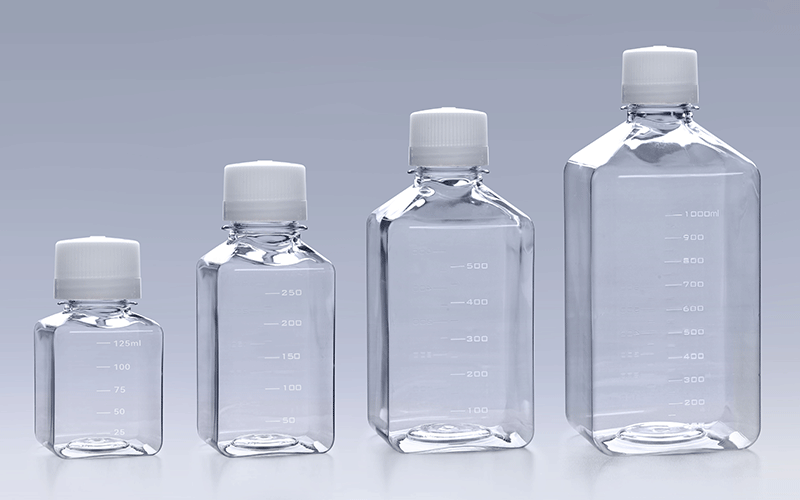
2. Vacuum Decay Testing
Vacuum decay testing is one of the most commonly used methods for evaluating sealing performance. The square media bottle is placed inside a specially designed test chamber, and the chamber is vacuumized so that the external pressure becomes lower than the internal bottle pressure.
If the bottle has good sealing integrity, the internal gas will not leak and the pressure will remain stable. If there is even a tiny leak, gas from inside the bottle will gradually escape, causing detectable pressure changes in the chamber. High-precision pressure sensors monitor these fluctuations in real time and can identify leakage holes as small as micron-level defects.
In general, vacuum decay testing can detect leak points smaller than 0.5 microns, ensuring reliable sealing performance under demanding conditions.
3. Pressure Retention Testing
Pressure retention testing evaluates sealing performance from another perspective. A certain amount of gas (usually air or nitrogen) is injected into the square media bottle to create internal pressure higher than the surrounding environment. The filling valve is then closed, and the pressure change inside the bottle is monitored.
Within a specified time period (such as 5–10 minutes), if the pressure drop remains within the acceptable threshold (for example, no more than 5%–10%), the bottle is considered to have good sealing performance.
This method simulates pressure variations that may occur during transportation, ensuring that the bottle can maintain sealing integrity under different environmental conditions.
4. Dye Penetration Testing
Dye penetration testing is commonly used to detect tiny leaks that are difficult to observe with the naked eye. The square media bottle is immersed in a liquid containing a dye solution, such as methylene blue, while pressure is applied inside the bottle or vacuum is applied externally.
If leakage points exist, the dye solution will penetrate into the bottle under pressure or vacuum conditions. After removing the bottle, inspectors check whether any dye traces appear inside the container to determine sealing performance.
This method provides a visual indication of leakage locations, making it easier to improve product design and manufacturing processes.
5. Accelerated Aging Testing
To evaluate long-term sealing stability, accelerated aging tests are also performed. The square media bottles are stored under harsh conditions such as high temperature and high humidity for a certain period, simulating long-term storage or extreme transportation environments.
After aging, the bottles undergo the same sealing performance tests described above to determine whether material aging or deformation has caused sealing failure.
Accelerated aging tests help manufacturers identify potential sealing risks in advance and ensure that the bottles can reliably protect liquid contents throughout their entire service life.
Conclusion
The sealing performance of square media bottles is verified through multiple complementary testing methods, ensuring reliable protection from different perspectives. These strict testing procedures provide strong assurance for the safe storage of liquids in biopharmaceutical research and production, while also reflecting the manufacturer’s commitment to quality control and product reliability.
The FAI climbed 5.9 percent year-on-year in the first 11 months of 2018, quickening from the 5.7-percent growth in Jan-Oct, the National Bureau of Statistics (NBS) said Friday in an online statement.
The key indicator of investment, dubbed a major growth driver, hit the bottom in August and has since started to rebound steadily.
In the face of emerging economic challenges home and abroad, China has stepped up efforts to stabilize investment, in particular rolling out measures to motivate private investors and channel funds into infrastructure.
Friday's data showed private investment, accounting for more than 60 percent of the total FAI, expanded by a brisk 8.7 percent.
NBS spokesperson Mao Shengyong said funds into weak economic links registered rapid increases as investment in environmental protection and agriculture jumped 42 percent and 12.5 percent respectively, much faster than the average.
In breakdown, investment in high-tech and equipment manufacturing remained vigorous with 16.1-percent and 11.6-percent increases respectively in the first 11 months. Infrastructure investment gained 3.7 percent, staying flat. Investment in property development rose 9.7 percent, also unchanged.