 English



Stem cell research has become one of the most rapidly advancing fields in life sciences, driving breakthroughs in regenerative medicine, tissue engineering, drug discovery, and cell therapy development. The success of any stem cell culture experiment depends not only on the culture medium and incubation conditions but also on selecting the appropriate cell culture flask.
A high-quality stem cell culture flask provides the optimal environment for cell attachment, proliferation, and maintenance of stem cell characteristics. In this article, we discuss the key factors to consider when choosing a cell culture flask for stem cell research and how the right culture vessel can improve experimental outcomes.
Why the Choice of Cell Culture Flask Matters
Stem cells are highly sensitive to their microenvironment. Factors such as surface treatment, flask design, material quality, and sterility can directly affect cell growth and viability.
An appropriate cell culture flask helps researchers achieve:
Consistent cell attachment
High cell viability
Improved proliferation rates
Reduced culture variability
Better reproducibility of experimental results
For laboratories working with mesenchymal stem cells (MSCs), induced pluripotent stem cells (iPSCs), or other adherent cell types, selecting the right flask is particularly important.
Surface Treatment: A Critical Consideration
TC-Treated Cell Culture Flasks
Most adherent stem cells require a surface that promotes efficient attachment and spreading. TC-treated cell culture flasks undergo surface modification to increase hydrophilicity and enhance cell adhesion.
Benefits of TC-treated flasks include:
Faster cell attachment
Uniform cell distribution
Improved growth consistency
Enhanced stem cell proliferation
For MSC culture and many other adherent stem cell applications, TC-treated flasks are generally the preferred option.
Non-Treated Flasks
Non-treated flasks are typically used for suspension cultures or specialized applications where cell attachment is not required.
Researchers should select flask surfaces based on the specific biological characteristics of their cell lines.
Selecting the Appropriate Flask Size
Different stages of stem cell research may require different flask formats.
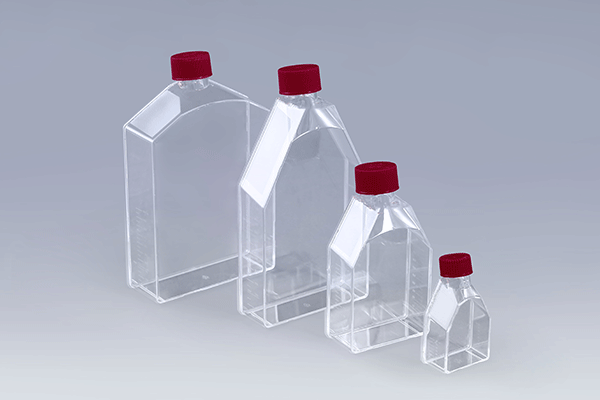
T25 Cell Culture Flask
Ideal for:
Initial cell recovery
Small-scale experiments
Cell line establishment
T75 Cell Culture Flask
Suitable for:
Routine stem cell culture
Expansion studies
Experimental optimization
T175 Cell Culture Flask
Recommended for:
Large-scale cell expansion
Preclinical research
High-yield cell production
Using the correct flask size helps maximize available growth area while maintaining efficient nutrient utilization.
Material Quality and Optical Clarity
High-quality cell culture consumables are typically manufactured from medical-grade polystyrene.
Important characteristics include:
Excellent transparency for microscopic observation
Consistent surface quality
Low particulate generation
Reliable mechanical strength
Clear visibility allows researchers to monitor stem cell morphology and confluency throughout the culture process.
Sterility and Quality Assurance
Stem cell cultures are highly susceptible to contamination. Therefore, sterility should never be compromised when selecting a cell culture flask.
Researchers should look for products that offer:
Gamma sterilization
DNase/RNase-free production
Endotoxin control
Batch traceability
Quality inspection reports
Reliable manufacturing standards help ensure reproducible results across multiple experiments.
Vented vs. Plug-Seal Caps
Vented Caps
Vented caps contain hydrophobic filters that allow gas exchange while reducing contamination risks.
Advantages include:
Improved oxygen and CO₂ exchange
Stable culture conditions
Reduced handling requirements
Plug-Seal Caps
Plug-seal caps provide a tighter seal and are often preferred when transportation or specialized culture conditions are required.
The choice depends on laboratory protocols and incubation systems.
Supporting Stem Cell Expansion
Successful stem cell expansion requires more than just selecting the correct culture medium. The culture vessel itself plays a significant role in maintaining cell health and proliferation.
When evaluating a stem cell culture flask, consider:
Surface treatment quality
Growth area requirements
Sterility standards
Optical clarity
Ease of handling
Scalability for future expansion
For laboratories planning to scale up from research to manufacturing, selecting compatible culture systems from the beginning can simplify process development.
Applications in Stem Cell Research
High-quality cell culture flasks are widely used in:
Mesenchymal stem cell (MSC) expansion
Induced pluripotent stem cell (iPSC) culture
Tissue engineering research
Cell therapy development
Drug screening studies
Regenerative medicine research
The right flask helps maintain stem cell characteristics while supporting efficient cell growth and experimental consistency.
Conclusion
Choosing the right cell culture flask for stem cell research is a critical decision that can significantly influence cell attachment, proliferation, and overall culture success. Factors such as surface treatment, flask size, sterility, and material quality should all be carefully evaluated.
High-quality TC-treated cell culture flasks provide an ideal environment for adherent stem cells, helping researchers achieve reliable and reproducible results. By selecting the appropriate culture vessel, laboratories can improve stem cell expansion efficiency and support the growing demands of regenerative medicine and advanced cell-based research.
The FAI climbed 5.9 percent year-on-year in the first 11 months of 2018, quickening from the 5.7-percent growth in Jan-Oct, the National Bureau of Statistics (NBS) said Friday in an online statement.
The key indicator of investment, dubbed a major growth driver, hit the bottom in August and has since started to rebound steadily.
In the face of emerging economic challenges home and abroad, China has stepped up efforts to stabilize investment, in particular rolling out measures to motivate private investors and channel funds into infrastructure.
Friday's data showed private investment, accounting for more than 60 percent of the total FAI, expanded by a brisk 8.7 percent.
NBS spokesperson Mao Shengyong said funds into weak economic links registered rapid increases as investment in environmental protection and agriculture jumped 42 percent and 12.5 percent respectively, much faster than the average.
In breakdown, investment in high-tech and equipment manufacturing remained vigorous with 16.1-percent and 11.6-percent increases respectively in the first 11 months. Infrastructure investment gained 3.7 percent, staying flat. Investment in property development rose 9.7 percent, also unchanged.