 English



Before moving adherent cell culture into larger vessels or multilayer systems, many laboratories first establish the process in cell culture flasks.
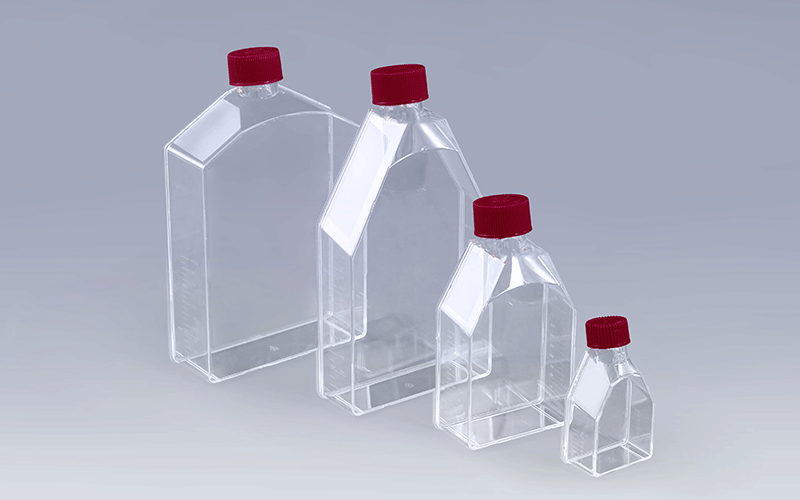
T25, T75, T175, and T225 flasks provide a practical platform for comparing culture conditions, optimizing key parameters, and understanding how cells respond before more material, medium, and operator time are committed to scale-up.
The goal of this stage is not simply to obtain more cells. It is to establish a repeatable culture process that can be transferred to a larger growth area with fewer unexpected changes.
Why Use T-Flasks During Process Development?
Cell culture flasks allow different conditions to be tested independently with relatively small quantities of cells and reagents.
They are commonly used to evaluate variables such as:
Seeding density
Medium formulation
Working volume
Feeding or medium exchange frequency
Target confluence
Harvest timing
Trypsinization conditions
Cell attachment and spreading
Because individual flasks can be handled separately, several conditions can be compared before selecting the parameters for the next stage.
Start with a Consistent Seeding Strategy
Seeding density is one of the first parameters to establish.
If density is too low, cells may recover slowly or grow unevenly. If density is too high, cultures may reach confluence too quickly and experience greater nutrient demand.
During process development, seeding density should normally be considered relative to the growth area, such as viable cells per cm².
This becomes especially important when moving from a T75 flask to a T175 or T225 flask. Maintaining a comparable surface-based seeding density provides a more meaningful starting point for scale-up.
Optimize Medium Volume and Exchange Timing
Medium requirements should also be established before increasing culture scale.
Process development can help determine:
Suitable working volume
How quickly medium conditions change
When medium exchange is needed
Whether full or partial exchange is appropriate
How feeding frequency changes as confluence increases
Using more medium does not automatically improve growth. The objective is to provide suitable culture conditions while avoiding unnecessary medium consumption.
Once a feeding strategy works consistently in T-flasks, it can provide a reference for larger-scale culture.
Define the Right Harvest Point
Waiting for maximum confluence is not always the best approach.
During development, laboratories should determine the harvest point that provides an appropriate balance between cell number and cell condition.
Useful observations include:
Cell morphology
Confluence
Viable cell yield
Detachment efficiency
Recovery after reseeding
Time required to reach the next passage
These data help define a repeatable harvest window rather than relying only on visual judgement.
Evaluate More Than Final Cell Yield
A higher final cell count does not necessarily mean that one culture condition is better.
Before scale-up, evaluation should also include:
Attachment efficiency
Growth uniformity
Morphology
Viability
Culture duration
Medium consumption
Harvest efficiency
Flask-to-flask consistency
For example, one condition may produce slightly more cells but require longer culture time, more medium, or more difficult harvesting.
The preferred process should support both biological performance and practical operation.
Use Larger Flasks to Confirm the Process
Once suitable conditions are identified in smaller T-flasks, the process can be confirmed in larger formats.
A typical development path might be:
T25/T75 → T175/T225 → Multilayer Cell Culture System
The transition from one size to another should preserve key parameters as consistently as practical, including:
Seeding density per cm²
Medium volume relative to growth area
Feeding strategy
Target confluence
Harvest procedure
Differences observed after changing flask size should be investigated before moving to the next scale.
When Is It Time to Move Beyond T-Flasks?
T-flasks are flexible for process development, but they become less efficient as the required growth area increases.
A larger-scale system may be appropriate when the process requires:
Many T175 or T225 flasks per batch
Repeated manual filling and harvesting
Large incubator capacity
More operator time
Greater consistency between multiple vessels
Higher total adherent cell yield
At this stage, a multilayer cell factory can provide more growth area within a consolidated culture system.
However, scale-up is usually more successful when seeding, feeding, attachment, growth, and harvesting parameters have already been established at the T-flask stage.
Building a Stronger Scale-Up Process
Cell culture flasks remain valuable during process development because they allow laboratories to test variables individually before committing to a larger-scale system.
FDCELL supplies sterile cell culture flasks in T25, T75, T175, and T225 sizes, with TC-treated and non-treated surfaces and different cap options available.
By defining seeding density, medium requirements, harvest timing, cell recovery, and culture consistency in T-flasks first, laboratories can build a more controlled foundation for subsequent adherent cell culture scale-up.
The FAI climbed 5.9 percent year-on-year in the first 11 months of 2018, quickening from the 5.7-percent growth in Jan-Oct, the National Bureau of Statistics (NBS) said Friday in an online statement.
The key indicator of investment, dubbed a major growth driver, hit the bottom in August and has since started to rebound steadily.
In the face of emerging economic challenges home and abroad, China has stepped up efforts to stabilize investment, in particular rolling out measures to motivate private investors and channel funds into infrastructure.
Friday's data showed private investment, accounting for more than 60 percent of the total FAI, expanded by a brisk 8.7 percent.
NBS spokesperson Mao Shengyong said funds into weak economic links registered rapid increases as investment in environmental protection and agriculture jumped 42 percent and 12.5 percent respectively, much faster than the average.
In breakdown, investment in high-tech and equipment manufacturing remained vigorous with 16.1-percent and 11.6-percent increases respectively in the first 11 months. Infrastructure investment gained 3.7 percent, staying flat. Investment in property development rose 9.7 percent, also unchanged.